Blink Shell vs Termius: Which Mobile SSH Client Should You Pick in 2026?
The two best-known mobile terminals solve different problems — Blink is the keyboard-first power shell for Apple devices, Termius is the sync-everywhere SSH manager. An honest breakdown, plus when neither is the right tool.
TL;DR: Pick Blink Shell if you're all-in on iPhone/iPad, want the deepest hands-on terminal (hardware keyboard, Vim modes, jump hosts, open source), and like its $19.99/year price. Pick Termius if you need the same client on desktop and mobile with hosts synced everywhere, a real SFTP GUI, or team vaults — and accept the higher $10/month (billed annually) price for sync. Both now speak Mosh, so connection durability is no longer the differentiator it used to be. And if the sessions you're keeping alive are AI coding agents rather than hand-typed shells, there's a third option built for exactly that — covered at the end.
Search for a serious terminal on iOS and you'll land on the same two names: Blink Shell and Termius. Both are mature, actively developed, and genuinely good — which makes the choice about fit, not quality. Having both in the Moshi comparison stable means we've spent real time in each; here's the field guide.
The philosophies
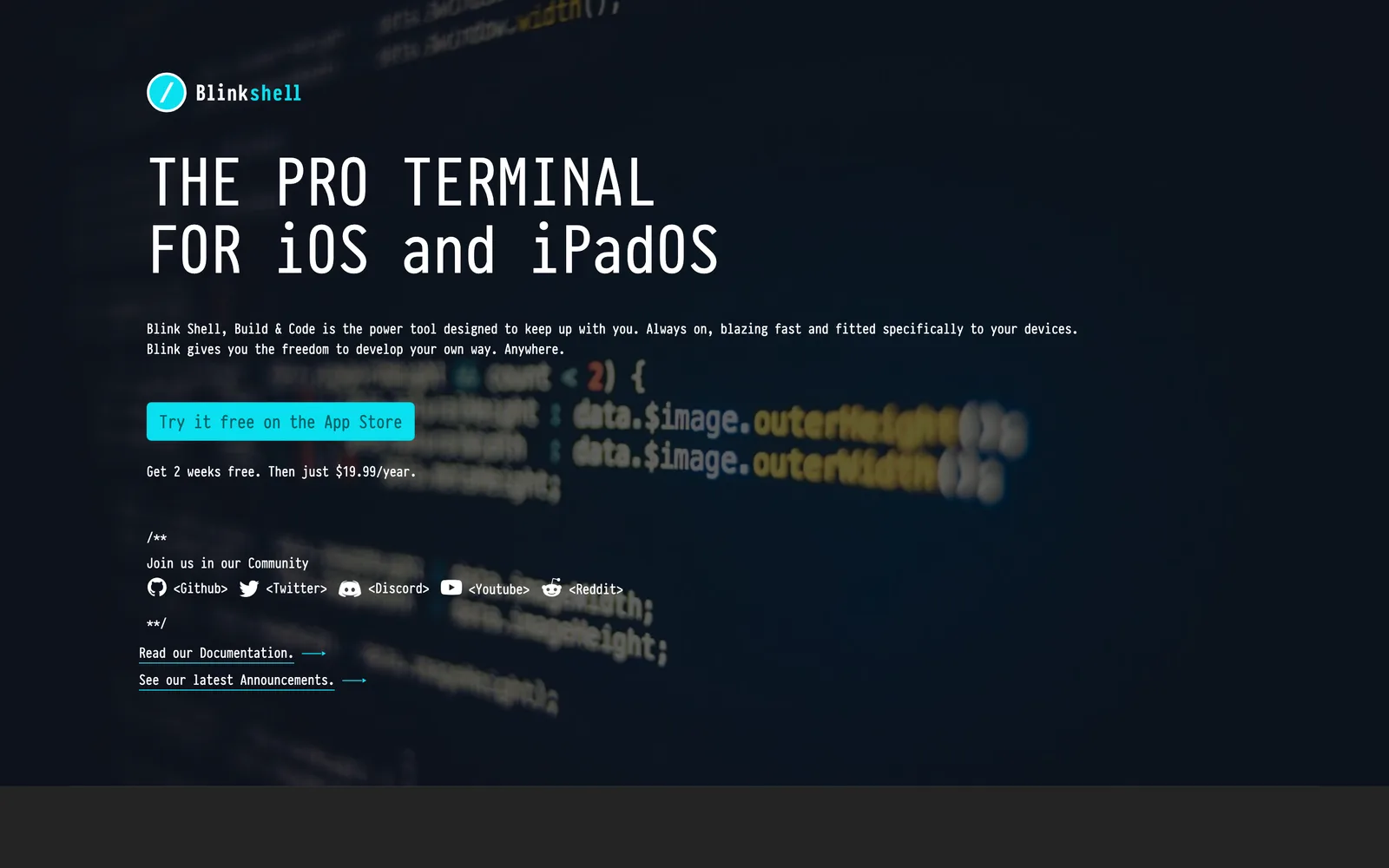
Blink (since 2016, open source under GPL-3.0) is a terminal in the fullest sense. It assumes you live in a shell, probably with a hardware keyboard, and it invests where that user feels it: emulation accuracy, font ligatures, complete key remapping, Vim and Emacs modes, Mosh as a first-class protocol, SSH config parsing, keys in the Secure Enclave. It's Apple-only — iPhone, iPad, Vision Pro — and treats iPadOS as a first-class desktop-ish platform with multi-window and external-display support.
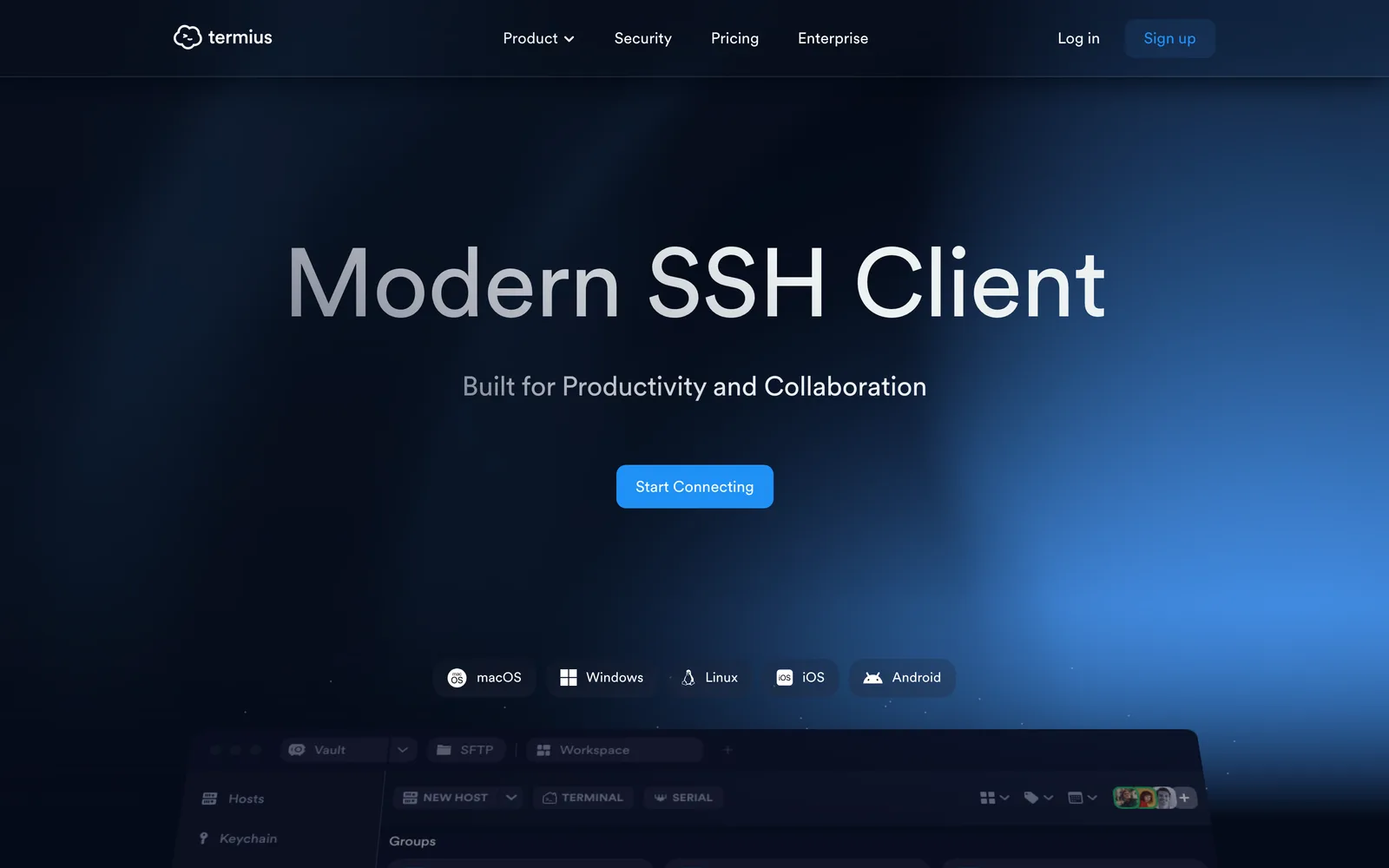
Termius is an SSH workflow manager that contains a terminal. Its center of gravity is the host list: organize hundreds of servers, tag them, share them with a team, and open any of them from any device — iOS, Android, macOS, Windows, Linux, even the browser — with everything synced through Termius's cloud. The terminal itself is competent and modern; the product is the layer around it.
That single difference — device-local power tool vs. synced service — decides most people's answer.
Feature by feature
| Blink Shell | Termius | |
|---|---|---|
| Platforms | iPhone, iPad, Vision Pro | iOS, Android, macOS, Windows, Linux, web |
| Protocols | Mosh (first-class), SSH | SSH, Mosh, Telnet, SFTP |
| Open source | Yes (GPL-3.0) | No |
| Hardware keyboard | Best-in-class: full remapping, Vim/Emacs modes | Good |
| SSH depth | Jump hosts, agent forwarding, local/remote/SOCKS5 forwards, cert auth | Jump hosts, port forwarding, snippets |
| File transfer | SFTP mounted into Files.app | Full SFTP GUI, best in class |
| Cross-device sync | iCloud (Apple only) | Cloud sync everywhere (Pro) |
| Team features | No | Shared vaults, $20–30/user/mo |
| Extras | Blink Code (VS Code UI), Blink Build (cloud VMs, $7.99/mo) | Snippets, autocomplete, team billing |
| Pricing | Free tier; Blink+ $19.99/yr | Free Starter; Pro $19.99/mo or $120/yr |
Connection durability: a former differentiator, mostly closed
For years the standard advice was "Blink, because Mosh." A plain SSH (TCP) session dies whenever a phone sleeps or hops networks; Mosh survives both, and Blink's decade-old Mosh implementation is excellent.
That gap has narrowed: Termius now ships Mosh support too (via its own compatibility library), and it's available even on the free Starter plan. In day-to-day use Blink's Mosh remains the more battle-tested of the two, and Termius's history as an SSH-first client shows in places — its long-lived sessions lean on keep-alives that cost battery where Mosh-native apps idle silently. But "Termius drops your session the moment you lock the phone" is no longer accurate, and you shouldn't choose on that basis alone.
If you want the protocol background — what Mosh actually changes and what it gives up — read Mosh vs SSH.
Pricing, honestly
- Blink+ is $19.99/year — about $1.67/month. For a tool this deep, it's the best value in the category. The free tier is genuinely usable; Blink+ removes limits and funds development. Blink Build, the optional on-demand cloud dev VMs, is a separate $7.99/month.
- Termius Pro is $19.99/month, or $10/month billed annually ($120/yr) — six times Blink's price. The free Starter tier is more generous than people expect (SSH, Mosh, SFTP, port forwarding included); what Pro really sells is cloud sync — your hosts on every device — plus autocomplete and other conveniences. Teams pay $20–30/user/month for shared vaults.
So the pricing question is really: is synced-everywhere worth ~$100/year over Blink? For a multi-platform consultant juggling client servers, often yes. For an Apple-only developer with three hosts, almost certainly no.
Choose Blink Shell if…
- You're on iPhone/iPad (or Vision Pro) only, and desktop sync doesn't matter.
- You use a hardware keyboard and want Vim/Emacs modes and full remapping.
- You value open source you can audit and build yourself.
- You need deep SSH plumbing — agent forwarding, SOCKS5, certificates.
- You want the lowest subscription price for a serious terminal.
Choose Termius if…
- You need the same client, same host list, on desktop and mobile — Windows and Android included.
- A graphical SFTP file manager is part of your daily workflow.
- You manage servers as a team and want shared vaults and central billing.
- You prefer a polished GUI for organizing many hosts over a config file.
The third option: if you're actually steering AI agents
Both apps above assume the thing on the other end of the connection is you, typing. In 2026, for a lot of developers, it's Claude Code or Codex doing the work — and the terminal's job becomes: keep the session alive, tell me when the agent needs me, and let me review what it did.
Neither Blink nor Termius has any concept of that. An agent blocked on a permission prompt is just text in a buffer; you find out by opening the app and reading scrollback.
That's the gap Moshi exists for: native Mosh like Blink, but with a host daemon that turns agent events into push notifications, lock-screen Live Activities, and an approval inbox — plus a side-by-side diff viewer, voice prompting, and one-tap screenshot paste into a prompt. It's deliberately narrower than either app here (no SFTP mount, no desktop client), and the head-to-heads are public: Moshi vs Blink and Moshi vs Termius.
Plenty of people run two of these apps: Blink or Termius for hands-on server work, Moshi for the agent loop.
FAQ
Is Blink Shell worth it over the free options?
If you spend real time in a mobile shell, yes. The free tier works, and $19.99/year is less than most single-purpose utilities. The open-source repo also means you can build it yourself if you'd rather trade time for money.
Does Termius support Mosh now?
Yes. Termius added Mosh support via its own compatibility library, and it's included in the free Starter plan alongside SSH, SFTP, and port forwarding. Blink's Mosh implementation is older and more battle-hardened, but the basic capability is no longer exclusive.
Which is better on iPad?
Blink, for most people — best-in-class hardware keyboard handling, multi-window, external displays, and Files.app SFTP mounts. Termius on iPad is solid but is essentially its phone experience on a bigger screen. The full iPad field, including local shells like a-Shell and iSH, is in the best iPad terminal roundup.
Can either notify me when a long task finishes?
Not from the background. Blink can ring a bell or banner from an escape sequence while you're looking at a session, but neither app can push to a locked phone when something happens in a backgrounded session — there's no server-side component to send it. This is the core difference agent-focused clients like Moshi built around.
What about Prompt 3?
Panic's Prompt 3 is a lovely, polished SSH client with a $19.99 one-time price — but it's SSH-only, no Mosh, so sessions die on sleep and network changes. Fine for occasional server maintenance from home; not built for mobile-first or long-running work.
Related Articles
- Best iOS Terminal App for AI Coding Agents — Moshi, Blink, Termius, and Prompt for agent workflows
- Best iPad Terminal App — the same field through an iPad lens
- Mosh vs SSH — the protocol difference that used to decide this comparison
- Moshi vs Blink — feature-by-feature, with where Blink wins
- Moshi vs Termius — feature-by-feature, with where Termius wins
- Complete Remote Coding Setup — Tailscale + Mosh + tmux, end to end
Resources
- Blink Shell — official site
- Termius — official site
- mosh — Mobile Shell
- Moshi — Mobile Terminal for Developers