Best iPad Terminal App in 2026: SSH, Mosh, and Local Shells Compared
The iPad is the best mobile terminal hardware Apple makes — big screen, great keyboards, all-day battery. Here's which terminal app to run on it, whether you're managing servers, coding over SSH, or steering AI agents.
TL;DR: For remote work — servers, coding, AI agents — the two serious picks are Moshi and Blink Shell, because both speak native Mosh and an iPad that sleeps aggressively needs it. Choose Moshi if your terminal time involves Claude Code, Codex, or other agents: side-by-side diffs, browser preview, and an approval inbox use the iPad screen better than raw scrollback. Choose Blink if you live on a Magic Keyboard and want the deepest hands-on shell on iPadOS. For a local sandbox with no server, a-Shell and iSH are free and capable within iPadOS limits.
An iPad with a keyboard is a strange, wonderful terminal machine. The screen fits a real side-by-side diff. Split View puts documentation next to your shell. The battery outlasts any laptop. And with Stage Manager, a terminal is just one window among several instead of a full-screen takeover.
But iPadOS also works against you in two specific ways, and they should drive your choice of app:
- There is no local Unix environment. iPadOS has no shell of its own, so every terminal app either emulates one in a sandbox (a-Shell, iSH) or connects to a real machine somewhere else (everything below). For actual development work, "terminal on iPad" almost always means remote terminal.
- iPads sleep hard and roam often. The moment the screen locks or you move between networks, a plain SSH connection is dead. That makes the Mosh protocol — which survives IP changes and sleep — matter more on iPad than anywhere else. If you've never met Mosh, Mosh vs SSH explains the difference in five minutes.
With that lens, here's the field.
The comparison
| Feature | Moshi | Blink Shell | Termius | Prompt 3 | a-Shell / iSH |
|---|---|---|---|---|---|
| Kind | Remote (Mosh, ET, SSH) | Remote (Mosh, SSH) + local sandbox | Remote (SSH, Mosh, SFTP) | Remote (SSH) | Local sandbox |
| Survives sleep & network switch | Yes (Mosh/ET) | Yes (Mosh) | Yes with Mosh | No | n/a |
| AI-agent features | Inbox, push, Live Activities, diffs, usage rings | No | No | No | No |
| Side-by-side diff viewer | Yes | No | No | No | No |
| Hardware keyboard depth | Good | Best-in-class | Good | Good | Basic |
| Stage Manager / Split View | Yes | Yes, plus external display | Yes | Yes | Yes |
| SFTP / file management | Git-aware repo browser | Files.app SFTP mount | Full SFTP GUI | Yes | Local files |
| Open source | No | Yes (GPL-3.0) | No | No | Yes |
| Price | Free; Pro $69.99/yr or $199 lifetime | Free; Blink+ $19.99/yr | Free; Pro $10/mo annual | $19.99 one-time | Free |
Moshi — the pick for AI-agent work on iPad
Moshi is a Mosh-native terminal built around one workflow: agents like Claude Code and Codex running on your machine, steered from wherever you are. On iPhone that means approvals from a lock screen. On iPad, the larger canvas changes what's practical:
- Diffs you can actually read. The diff viewer renders the working tree side-by-side, syntax-highlighted — on an iPad it reads like a desktop code review, not a squint. A Browse tab walks the repo at any commit.
- Preview the running app next to the shell. Browser preview opens the dev server your agent just started (
vite,next dev, Storybook) in-app, tunneled over your session — no public URL. On iPad, that's the terminal and the result of the change on one screen. - Split View that stays useful. Keep the spec, a ticket, or Safari beside the live session while an agent works; approvals and Live Activities keep arriving.
- An inbox instead of scrollback-hunting. With the host daemon installed, every approval request, question, and finished turn from Claude Code, Codex, OpenCode, Cursor, and friends lands as a card you can act on — plus usage rings for rate-limit windows before you kick off a long run.
- Keyboard both ways. A Magic Keyboard gets a real Ctrl/Esc/Tab/arrow experience with tmux prefix shortcuts; touch-first use gets the configurable D-pad and shortcut builder with per-agent sets.
- One license, all devices. A single Pro purchase covers iPhone, iPad, and Apple Watch together — up to three devices share hosts, dictation quota, and push. See Licensing.
Underneath it all: native Mosh (plus ET for UDP-hostile networks) rendered by a GPU Ghostty-based engine, so an iPad that slept through an hour of agent output reconnects instantly and scrolls smoothly.
The honest limits: no general SFTP mount, deliberately simple SSH extras (no arbitrary port forwarding beyond localhost preview), not open source.
Blink Shell — the pick for keyboard-first iPad coding
Blink Shell has been the power user's iOS terminal since 2016, and the iPad is its home turf. If your ideal setup is an iPad Pro, a Magic Keyboard, and vim over Mosh, Blink is the best tool on the platform, full stop:
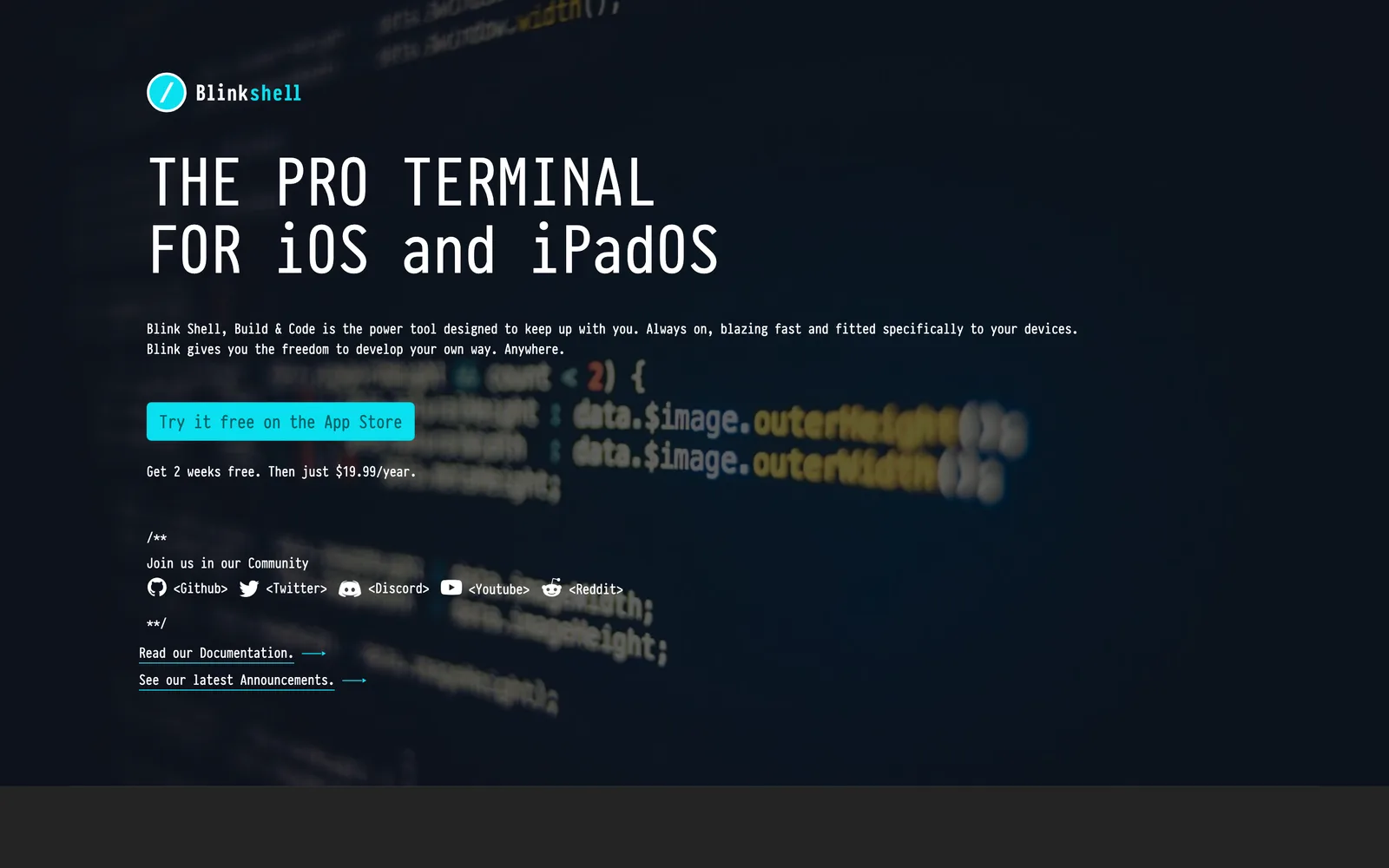
- Best-in-class hardware keyboard support — full key remapping, Vim/Emacs modes, an external-keyboard config that rivals a desktop.
- Real iPadOS citizenship — multi-window, external-display support, and Files.app SFTP mounts so remote filesystems appear system-wide.
- Deep SSH — jump hosts, agent forwarding, local/remote/SOCKS5 forwarding, certificate auth, Secure Enclave keys.
- Open source (GPL-3.0), with Blink Code (a VS Code front-end) and Blink Build (on-demand cloud dev VMs) layered on.
What Blink doesn't have is any concept of an agent: no push when Claude Code is blocked on a y/n, no diff viewer, no approval surface — an agent waiting for input is text in a buffer you have to go read. For hands-on shell work that's irrelevant; for agent-driven days it's the whole gap. The full head-to-head is at Moshi vs Blink.
Termius — the cross-platform generalist
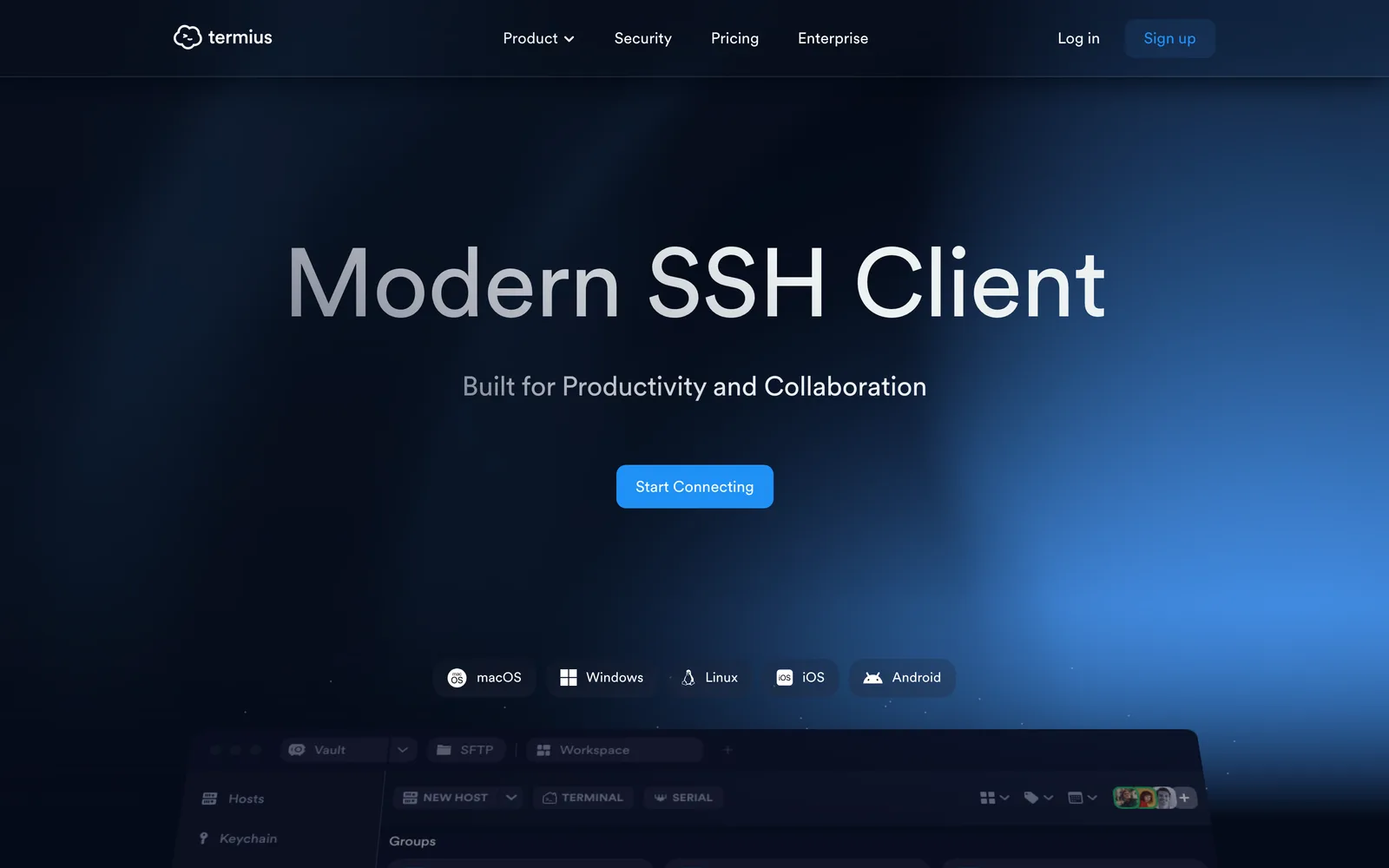
Termius runs everywhere — iPad, iPhone, Android, macOS, Windows, Linux — and syncs hosts across all of it (sync requires the Pro plan). It has the best SFTP GUI of the group, arbitrary port forwarding, snippets, and team vaults, and it has added Mosh support on top of its SSH core. As a general server-administration client on iPad it's polished and capable; what it lacks is any agent awareness and the phone-first durability engineering of the Mosh-native pair. Details: Moshi vs Termius.
Prompt 3 — polished, SSH-only
Panic's Prompt 3 is a beautifully built SSH client with a one-time $19.99 price. But it's SSH-only — no Mosh — which on an iPad means every sleep or network change is a frozen session. Fine for occasional, at-home server pokes; wrong tool for mobile-first or long-running work.
a-Shell and iSH — local, free, sandboxed
Two free, open-source apps give you a shell on the iPad itself, no server involved:
- a-Shell runs a curated set of Unix commands (plus Python, Lua, JavaScript) compiled to WebAssembly, with tight Shortcuts integration.
- iSH emulates x86 Alpine Linux, so
apkinstalls real packages — impressively compatible, though the emulation is slow by design.
Both live within iPadOS sandbox rules: no background daemons, no Docker, no real toolchains for serious builds. They're genuinely useful for scripting, learning, and quick file wrangling — and the honest answer to "can the iPad itself be my dev machine?" is still "not for real projects." The pattern that works is a local sandbox for scratch work plus a remote terminal to a machine that does the heavy lifting — for that setup, see Using Your Mac as a Remote Agent Machine.
The verdict
- You steer AI coding agents (or want to start): Moshi. The iPad screen turns its diff viewer and browser preview from conveniences into the main event, and the inbox means the iPad can stay in the bag until an agent actually needs you.
- You write code by hand over SSH with a Magic Keyboard: Blink Shell. Nothing on iPadOS matches its keyboard and shell depth, and it's open source.
- You administer many servers across many platforms: Termius, for the sync, SFTP, and team features.
- You want a free local sandbox: a-Shell (speed, Shortcuts) or iSH (real Alpine packages).
Plenty of developers run two of these — Blink or Termius for hands-on work, Moshi for the agent loop. They coexist fine; the machine on the other end doesn't care.
FAQ
Can I do real development on an iPad without a remote machine?
Not comfortably. iPadOS has no local toolchain, no Docker, and no background processes, so local shells (a-Shell, iSH) top out at scripting and file work. The workable pattern is a remote machine — a Mac at home, a Linux box, WSL on Windows, a cloud VM — with the iPad as the terminal. This guide shows the always-on Mac version of that setup.
Why does Mosh matter more on iPad than on a laptop?
iPads suspend apps and drop network connections aggressively to save battery, and move between Wi-Fi networks and cellular constantly. Each of those events kills a plain SSH (TCP) session; Mosh's UDP state-sync protocol shrugs them all off. Mosh vs SSH has the full breakdown.
Do these apps support Stage Manager and Split View?
Yes — Moshi, Blink, Termius, and Prompt all run in Split View and Stage Manager. Blink goes furthest with external-display support; Moshi leans into Split View for the agent workflow — terminal in one pane, spec or preview in the other.
What's the best free terminal for iPad?
Locally, a-Shell and iSH are free and open source. For remote work, Moshi, Blink, and Termius all have free tiers that cover basic SSH/Mosh use; the paid tiers unlock each app's specialty (agent features, Blink+ conveniences, cross-device sync respectively).
Does one Moshi purchase cover iPhone and iPad?
Yes — Moshi is a universal app, and one Pro license covers up to three devices (iPhone, iPad, Apple Watch) with shared hosts, dictation quota, and unified push. See Licensing and sharing.
Related Articles
- Best iOS Terminal App for AI Coding Agents — the iPhone-angle roundup of the same field
- Mosh vs SSH — why the protocol choice decides your mobile experience
- Moshi vs Blink — the two Mosh-native terminals, head to head
- Moshi vs Termius — versus the cross-platform SSH client
- Moshi vs Claude Code Remote Control — free first-party Claude remote vs cross-vendor agent terminal
- Complete Remote Coding Setup — Tailscale + Mosh + tmux, end to end
- Using Your Mac as a Remote Agent Machine — the server side of the iPad setup
- Diff viewer — the agent-review surface that shines on iPad
- Keyboard — Moshi's D-pad, shortcut builder, and hardware-keyboard support